Tarot Spreads & Reading: From Beginner to Confident Reader
By Blair Andrews · Published April 19, 2026
Owning a tarot deck is easy. Knowing what to do with it is another story. If you have ever shuffled your cards, laid them out on the table, and thought "Now what?" - you are in exactly the right place. Learning to read tarot is not about memorizing 78 definitions.
It is about building a practice: asking honest questions, choosing a spread that fits the moment, and trusting your response to what you see.
This page gathers the best reading guides on the site in one place, organized by skill level. Whether you are pulling your very first daily card or refining your approach to complex multi-card layouts, the articles below will help you develop confidence without losing the intuitive spark that makes tarot personal.
The most important thing any tarot reader can learn is this: the cards do not give you answers. They give you better questions. The articles below will show you how to ask those questions, how to arrange the cards so the answers have room to unfold, and how to trust what you hear - even when it surprises you.
Related: Tarot Card Meanings: Your Complete Guide to Every Card
KEY TAKEAWAYS
Learning to read tarot is a practice, not a memorization exercise. Start with daily single-card pulls, progress to three-card spreads, then explore seasonal layouts and reversed cards. The quality of a reading depends on the quality of the question you ask.

Getting Started
Every tarot journey begins with a single card. Before you worry about complex spreads or memorizing all 78 meanings, start by pulling one card each morning and sitting with its energy throughout the day. Notice how the card's theme shows up in your interactions, decisions, and feelings.
This daily practice builds a personal relationship with your deck that no amount of textbook study can replicate. Over time, you will find that you simply know what a card means because you have lived with it.
Choosing your first deck matters more than most beginners realize.
The imagery, the art style, and even the weight of the cards in your hands all influence how naturally the intuitive connection flows. Some readers thrive with the classic Rider-Waite imagery because it is rich with symbolic detail.
Others prefer more modern or minimalist decks that leave more room for personal interpretation. There is no wrong answer, only the deck that speaks to you.
- How To Read Tarot For Yourself in 5 Simple Steps
- How to Choose a Tarot Deck That's Right for You
- 4 Reasons You Need To Pick Up a Tarot Deck Now

Understanding Tarot Spreads
A tarot spread is simply a pattern in which you lay out your cards, with each position assigned a specific meaning. The spread you choose shapes the reading.
A single-card pull answers the question "What do I need to know right now?" while a three-card spread adds narrative structure, showing how a situation has evolved, where it stands, and where it is heading. The spread acts as a container for the story the cards are trying to tell you.
The most popular spread for beginners is the three-card layout. It is versatile enough to address nearly any question while remaining simple enough that you are not overwhelmed by information. Common variations include past/present/future, situation/challenge/advice, and mind/body/spirit.
Each variation uses the same three positions but shifts the lens through which you interpret the cards, giving you a different angle on the same situation.
For deeper exploration, five-card spreads add nuance by including positions for underlying influences and potential outcomes.
A typical five-card cross layout places one card at the center representing the present situation, one above for your aspiration, one below for the foundation of the issue, one to the left for the recent past, and one to the right for the near future.
This layout gives you enough context to understand the full picture without the complexity of larger spreads.
The Celtic Cross is the most well-known complex spread, using ten cards to provide a comprehensive overview of a situation. It covers the present, the challenge, the subconscious influence, the recent past, the possible outcome, the near future, your attitude, external influences, hopes and fears, and the final outcome.
The Celtic Cross is best reserved for significant life questions where you want a thorough, multi-layered reading. It can feel overwhelming for beginners, so work your way up to it after you are comfortable with simpler layouts.
Relationship spreads deserve special mention because they are among the most commonly requested readings.
A simple two-card relationship spread places one card for each person, revealing their current energy and perspective.
More detailed versions add a third card between them to represent the dynamic of the relationship itself, a fourth card for the challenge the couple faces, and a fifth for the potential direction of the connection. These spreads work for romantic relationships, friendships, family bonds, and even professional partnerships.

Spreads & Layouts

Reading Techniques
The art of reading tarot goes far beyond knowing what each card means.
It involves learning how to ask the right questions, how to read cards in relationship to one another, and how to trust the impressions that arise spontaneously as you look at the spread.
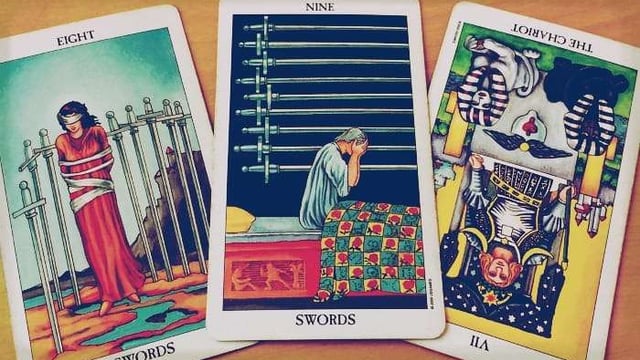
Reversed cards, where a card appears upside down, add another dimension of meaning. Some readers interpret reversals as blocked or internalized energy, while others see them as a softer or more nuanced expression of the card's upright meaning.
Knowing when to consult the tarot and when to step back is a skill that develops with experience. Pulling cards obsessively about the same question rarely produces clarity.
It usually produces confusion, because you are asking the deck to tell you what you want to hear rather than what you need to know. A good rule is to ask a question once, sit with the answer, and return to the cards only when the situation has genuinely changed or when a new question has emerged.
Reading tarot for others introduces a whole new set of considerations. You become a translator between the cards and another person's experience, which requires empathy, clear boundaries, and the humility to admit when you are not sure what a card means.
The best readings happen when the reader creates a safe space for honest reflection rather than performing a dramatic prediction.
- The Powerful Questions You Can Ask During Your Reading
- How To Read Reversed Tarot Cards
- How To Make a Tarot Cheat Sheet
- 5 Rules for Reading Tarot for Your Friends

When to Use Each Spread
Choosing the right spread is as important as choosing the right question. For daily guidance and quick check-ins, a single-card pull is all you need. It keeps your practice consistent without requiring a large time investment.
For specific decisions or situations where you need to understand how things are developing, the three-card spread offers the ideal balance of depth and simplicity.
Use a five-card spread when you need more context than a three-card layout provides but do not want the full complexity of the Celtic Cross.
It works beautifully for career questions, creative projects, and situations where multiple factors are at play. Reserve the Celtic Cross for major life crossroads, annual reviews, or questions that involve many moving parts and long time horizons.
Relationship spreads should be used thoughtfully. The most honest readings happen when you focus on your own role in the dynamic rather than trying to predict what the other person will do. Asking "What can I learn about how I show up in this relationship?" produces a far more useful reading than "Does this person love me?"

Deepening Your Practice
Once you have established a comfortable reading routine, tarot journaling becomes a powerful tool for growth. Recording your daily draws, your interpretations, and what actually happened allows you to track patterns over time and refine your understanding of each card.
Many experienced readers find that their journal becomes as valuable as the deck itself, a personal reference guide built entirely from lived experience.
Understanding the three main tarot systems, Rider-Waite-Smith, Thoth, and Marseille, can also deepen your practice by showing you different philosophical approaches to the same archetypes. Each system emphasizes different aspects of the cards, and exploring them gives you a richer vocabulary for interpretation.