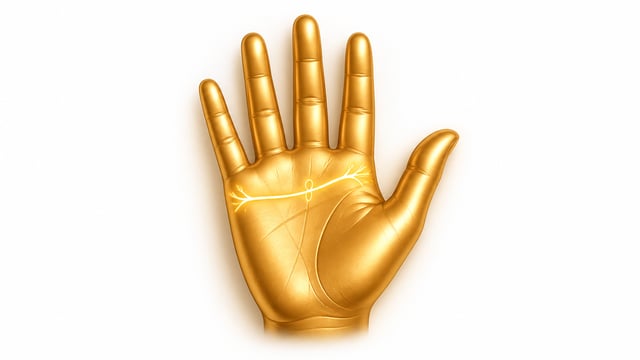
Mounts of the Palm: Where Your Energy Lives
By Blair Andrews · Published April 21, 2026 · Updated May 10, 2026
Everyone wants to talk about the lines. The Heart Line, the Life Line, the Fate Line. These are the celebrity features of palmistry, the ones that get all the attention. But experienced palmists will tell you something different.
They will tell you that the mounts, those fleshy, raised areas beneath each finger and around the palm's edges, reveal something the lines cannot: where your energy actually lives.
Lines show what happens to you. Mounts show what you are made of. They reveal the raw material of your character, the reserves of energy you carry, the planetary forces that shaped your temperament before a single line was formed. If the lines are the rivers on a topographic map, the mounts are the mountains and valleys that give those rivers their direction.
And unlike lines, mounts are visibly dynamic. They physically grow and shrink based on your current engagement with those energies. A period of intense creative work will literally plump the Mount of Apollo beneath your ring finger. A season of withdrawal will soften the Mount of Jupiter. Your palm is not a photograph. It is a living weather system.

How to Read Your Mounts
Reading the mounts is more tactile than reading lines. You cannot simply look - you must feel. Press gently on each area and notice what you encounter.
A full, firm mount means that planetary energy is active and expressing itself through your life. A flat mount does not mean the energy is absent - it means the energy expresses quietly, through internal channels, or is currently depleted. An overly puffy, spongy mount signals excess, too much of that energy without adequate grounding.
Mounts change. They are not permanent. A musician who stops playing for two years will often notice their Mount of Apollo flatten. Someone who enters a leadership role will watch their Jupiter fill. You can literally track your engagement with life by monitoring these pads of flesh.

The System Behind the Mounts
The mounts are batteries, storing planetary energy. The lines are roads along which that energy travels. The fingers are conduits that direct it outward into the world.
What makes this system particularly interesting is that it did not develop in isolation. The same Renaissance philosophers who mapped the planets onto the hand also mapped each planet to a specific number. And those same planetary energies show up in the tarot's Major Arcana cards. Three systems (palmistry, numerology, and tarot) all built on the same planetary framework, reading the same forces through different lenses.

The Seven Classical Mounts
Mount of Jupiter - The Number 3
Located at the base of the index finger, Jupiter governs ambition, leadership, and your relationship with authority. In the oldest number traditions, Jupiter carries the number 3: growth, creative expression, and teaching.
A well-developed Jupiter mount creates natural teachers and organizers. These people want to lift others as they rise - their ambition is social, not solitary. They make decisions easily and carry an unmistakable sense of personal dignity. A flat Jupiter indicates someone who genuinely prefers supporting roles. An overly prominent one warns of ego overpowering collaboration.
In the tarot, Jupiter governs the Wheel of Fortune and the Hierophant, the teacher figure. People with strong Jupiter mounts often become the person others come to for guidance without consciously choosing that role. A triangle on this mount signals talent for diplomacy; the rare Ring of Solomon (a semicircular line at the finger base) indicates profound wisdom and natural counseling ability.
Mount of Saturn - The Number 7
Beneath the middle finger sits the most introspective mount on the palm. Saturn governs wisdom, discipline, and the kind of depth that only comes from sustained inner work. The classical tradition assigned Saturn the number 7: the seeker, the analyst, the person who needs to understand things before accepting them.
A well-developed Saturn mount indicates a deep thinker who trusts process over shortcuts and gravitates toward research, philosophy, or science. A flat Saturn is common and simply means the person learns by doing rather than contemplating. An overly prominent one can indicate excessive isolation or a tendency to overthink until action becomes impossible.
Saturn's tarot card is the Hermit, the solitary figure holding a lantern, lighting the way through inner darkness. The Hermit is not lonely. The Hermit is looking for something specific, and the search requires going alone.
Mount of Apollo (The Sun) - The Number 1
Beneath the ring finger, Apollo radiates creative energy. The Sun carries the number 1, unity, individuality, the source from which everything else radiates. When someone with a prominent Apollo mount arranges a room, chooses colors, or plays a melody, people respond. There is an effortless rightness to their creative choices.
The Sun Line, when present, terminates on this mount, amplifying its significance enormously. A strong Sun Line meeting a full Apollo mount is one of the clearest markers of creative destiny in palmistry. A flat Apollo mount means creative energy flows inward, producing exquisite taste, but a preference for appreciating beauty over producing it publicly.
The tarot connection is the Sun card: joy, radiance, creative confidence.
Mount of Mercury - The Number 5
Beneath the little finger, Mercury governs all forms of communication and exchange. Mercury's number is 5, adaptability, restless intelligence, and the need for variety. This mount encompasses more than speech: writing, negotiation, wit, and - in the classical tradition - healing ability. The ancient palmists considered it essential for doctors, writers, and merchants alike, because all three require the same skill: understanding what another person needs and delivering it.
A full Mercury mount indicates someone who thinks quickly and instinctively adjusts their communication to their audience. A flat one suggests communication through action or art rather than verbal fluency. Mercury rules the Magician in tarot, translating intention into reality through pure skill.
Mount of Venus - The Number 6
The largest mount on the palm, the thick, fleshy pad at the thumb base, holds your capacity for love, passion, and raw vitality. The Life Line encircles it like a river around fertile land. Venus carries the number 6: love, harmony, and beauty. Six was called "the most perfect number" because its parts (1, 2, and 3) add up to itself.
A full Venus mount indicates warmth, generosity, and magnetic physical charm. These people draw others through sheer aliveness. A flat Venus mount does not mean coldness; it means affection expressed through acts of service, steadfast loyalty, and carefully chosen words rather than physical warmth.
The tarot's Empress card belongs to Venus: abundance, sensuality, nurturing something into full bloom. One practical note: persistent discoloration on this mount has long been correlated with circulatory issues. Not diagnosis, but worth checking with a physician.
Mount of Luna (The Moon) - The Number 2
Along the outer palm edge below the little finger, Luna governs imagination, intuition, and the subconscious. The Moon's number is 2, sensitivity, receptivity, and partnership. The Moon does not generate its own light; it reflects. People with strong Luna mounts work the same way - they pick up on signals that others miss entirely.
A prominent Luna indicates vivid dreams, strong gut feelings, and a pull toward the mysterious. The classical tradition associated this mount with poets, mystics, and seafarers - people who navigate by something other than visible landmarks. Horizontal lines crossing Luna's lower portion indicate restlessness that craves new horizons.
Two tarot cards share Luna's energy: the High Priestess, who guards the threshold between conscious and unconscious knowledge, and the Moon card itself.
The Plain of Mars - The Number 9
The center of the palm is not a mount but a plain, a hollow. Mars carries the number 9: the warrior, the humanitarian, the person willing to fight for something larger than themselves. A firm, shallow Plain of Mars indicates resilience. A soft, deeply hollow plain suggests sensitivity to conflict and a tendency to absorb environmental tension.
The classical tradition divides Mars into two positions. Mars Upper (between Jupiter and Venus) governs self-defense. Mars Lower (between Mercury and Luna) governs defending others. New parents often develop a pronounced Mars Lower within months - the protective instinct literally reshaping the hand.
Mars energy shows up in tarot as Strength (quiet inner courage) and the Tower (sudden, forceful transformation).

The Planetary Reference Table
All seven mounts carry planetary numbers from the same tradition that gave us modern numerology. The Renaissance thinkers who systematized these number-to-planet correspondences were working from the same source material as the palmists.
| Mount | Planet | Number | Core Themes | Tarot Card |
|---|---|---|---|---|
| Jupiter | Jupiter | 3 | Expansion, leadership, teaching | Wheel of Fortune / Hierophant |
| Saturn | Saturn | 7 | Discipline, wisdom, solitude | The Hermit |
| Apollo | Sun | 1 | Creativity, vitality, self-expression | The Sun |
| Mercury | Mercury | 5 | Communication, commerce, adaptability | The Magician |
| Venus | Venus | 6 | Love, harmony, beauty | The Empress |
| Luna | Moon | 2 | Intuition, imagination, receptivity | High Priestess / The Moon |
| Mars | Mars | 9 | Courage, drive, humanitarian action | Strength / The Tower |
When your dominant mount, its number, and its tarot card all point in the same direction, you are seeing the same truth through three different windows.

The Outer Planet Mounts
The deeper traditions recognize additional mount formations that appear in a minority of hands.
Neptune occupies a triangular area at the palm's base, between Luna and Venus. It appears clearly in about seven percent of hands and serves as a bridge between unconscious creativity and physical vitality - the ability to take what you receive from the invisible world and make it real. Artists who channel rather than construct. Healers who sense what is wrong before examination confirms it.
Uranus, considered the higher octave of Mercury, indicates a mind that receives information in flashes rather than sequences. Vanishingly rare in pronounced form. Scientists who see solutions whole before working backward to prove them.
Pluto, the higher octave of Mars, marks people who have lived many lives within one lifetime - complete reinventions so thorough that their twenties and forties might belong to different people. A pronounced Pluto mount means the universe will not allow you to stagnate.

The Mudra Connection
When you touch your thumb to each finger, you create a circuit - Venus energy connecting to each planetary finger in turn. This is precisely what Buddhist and Hindu mudra practice has taught for thousands of years, drawing from the same ancient Indian tradition that gave palmistry its planetary framework.
Thumb to index finger: Venus meets Jupiter - calm expansion. Thumb to middle finger: Venus meets Saturn - inward focus, patience. Thumb to ring finger: Venus meets Apollo - creative energy and self-worth. Thumb to little finger: Venus meets Mercury - clear thought and precise communication.
That palmistry and mudra practice arrive at the same energetic map through entirely different cultural lineages is convergent evidence - two traditions discovering the same architecture of the hand.

Your Mounts and Your Life Path
If you work with numerology, your Life Path number connects directly to specific planetary energies - the same energies the mounts are built on. The connection works through the planetary number system:
- Life Path 1 - Sun/Apollo energy. Look at your Mount of Apollo for self-expression and creative force.
- Life Path 2 - Moon/Luna energy. Check your Mount of Luna for sensitivity and intuition.
- Life Path 3 - Jupiter energy. Your Mount of Jupiter reflects expansion and social magnetism.
- Life Path 4 - The builder's number. LP4 energy shows up in the firm, grounded quality of the hand overall - solid palms, practical hands made to create lasting structures. Some traditions connect it to Saturn (discipline), others to Uranus (unconventional methods).
- Life Path 5 - Mercury energy. Your Mount of Mercury reflects communication and adaptability.
- Life Path 6 - Venus energy. Your Mount of Venus holds your devotion to home and harmony.
- Life Path 7 - Saturn and Luna energy. Many LP7 individuals show development in both mounts, reflecting the pull toward both solitude and mystery.
- Life Path 8 - Saturn and Jupiter energy. Authority and material mastery, ambition combined with discipline.
- Life Path 9 - Mars energy. Your Plain of Mars holds the warrior-humanitarian spirit.
Test it on your own hand. Calculate your Life Path, then find your dominant mount. When it matches, your hand and your numbers are telling the same story. When it diverges, that tension suggests an energy you are developing that was not part of your original blueprint.

Finding Your Dominant Mount
Press gently but firmly on each mount using the pad of your opposite thumb. Compare fullness, firmness, and resilience. The fullest is your dominant mount - the energy that defines your natural mode of being. Most people have one clearly dominant mount and one or two secondary ones.
Once you have identified it, check the reference table above. Find its number and its tarot card. Then compare it to your Life Path. When all three systems point the same direction, you are not finding a coincidence - you are reading the same truth through different languages.