Palm Reading Guide: What the Lines on Your Hands Reveal About Your Life
By Blair Andrews · Published April 20, 2026 · Updated May 10, 2026
The moment someone opens their hand for a reading, they change. The bravado drops. The hand is personal in a way a birth date isn't. It's your body, your history, written in a language you've been carrying around your whole life without knowing how to read it. The lines aren't random creases. They are a map, drawn by your own nervous system, shaped by your thoughts and your choices.
Palm reading, or palmistry, is one of the oldest forms of divination on Earth, practiced across every culture from ancient India to medieval Europe to the courts of China. And the reason it has endured is simple: it works.
Not in the way fortune-telling works in the movies. Nobody is going to look at your hand and tell you you'll die on a Tuesday. What palmistry actually reveals is far more useful: the texture of your mind, the landscape of your emotional world, the strength of your vitality, and the threads of purpose running through your story.
A Tradition With Documented Practitioners
The modern Western tradition of detailed, systematic palmistry (the one described on this page) comes primarily from the late 19th and early 20th centuries. Its most prominent practitioners didn't read palms in carnival tents. They consulted for generals, heads of state, and some of the most famous writers and public figures of their era.
The most striking example: Cheiro, Count Louis Hamon, who read palms for Mark Twain, Oscar Wilde, and Edward VII, made specific written predictions years before the events occurred. He predicted Kitchener would play a crucial role in a major European conflict, twenty years before that conflict began. The prediction was documented in advance in Cheiro's World Predictions, not reconstructed after the fact.
That kind of evidence doesn't prove palmistry in the scientific sense. But it establishes that this is a tradition with serious practitioners whose documented accuracy has never been explained away.
Cheiro didn't treat palmistry as a standalone system. He also calculated birth numbers and studied planetary cycles.
Multiple symbolic systems, applied to the same person, looking for the same patterns. The integrated approach this site takes isn't a modern invention - it's what the tradition's most respected figures actually practiced.
Why the Palm Is Not an Arbitrary Surface
The palm is one of the most neurologically dense surfaces of the human body. In 1853, Georg Meissner documented that tactile nerve corpuscles arrange themselves in straight lines in the skin of the palm - precisely along the pathways that form the major lines. Earlier research on palm nerve fiber distribution had already established that the hand's sensory network is extraordinarily concentrated.
These findings don't prove palmistry in a clinical sense. But they do establish something important: the lines palmists trace follow pathways that anatomists have independently mapped as nerve-fiber channels.
Your palm is a living document. The lines change as you change. And learning to read them is, in a very real sense, learning to read yourself.

How Palm Reading Works
Which Hand Do You Read?
The first question everyone asks is: which hand do you read? The answer is both - but they tell different stories.
Your non-dominant hand shows the inherited template: family patterns, predispositions you arrived with, the psychological starting point you didn't choose. Your dominant hand (the one you write with) shows the life you're actually living and building.
When the two hands tell very different stories, you are looking at a person who has significantly departed from their starting conditions. Sometimes that means growth. Sometimes it means constraint. But that divergence, the distance between what you were given and what you've made of it, is often the most revealing part of a reading.
The Shape of the Hand Itself
Experienced palmists assess the hand's overall shape and structure before reading a single line. The classification system most Western palmists still use comes from Casimir d'Arpentigny, refined by later practitioners including William Benham. It recognizes seven basic types, each carrying its own energy signature.
The Elementary hand is thick and stiff with few clear lines: practical, instinct-driven, built for physical work and direct experience. The Square hand has a square palm and square fingertips, orderly, methodical, reliable, drawn to systems and routines.
The Spatulate hand has fan-shaped fingertips broader at the base or tip, restless, inventive, energetic, always looking for the next project. The Philosophic hand shows knotted finger joints and a long palm. Analytical and introspective, the natural deep thinker who needs to understand before acting.
The Conic hand has smooth fingers tapering to rounded tips; intuitive, aesthetic, responsive to beauty and mood. The Psychic hand is long, narrow, and delicate. Highly sensitive, idealistic, often more comfortable in the inner world than the practical one. And the Mixed hand combines elements of several types, adaptable, versatile, harder to define but often the most interesting to read.
You don't need to identify your exact type to begin reading. But noticing whether your hand is thick or thin, stiff or flexible, square or tapered gives you a baseline before the lines add their detail. For a full exploration, see our hand shapes guide.
Three Layers of Reading
Reading a palm involves three layers. The lines - those flowing marks across the surface - speak to the major themes of your life: heart, mind, vitality, and destiny.
The mounts - the fleshy raised areas beneath each finger and around the edges of the palm - reveal where your energy naturally gathers, which planetary influences shape your character. And the fingers themselves - their length, shape, and spacing - add further nuance.
Today, we'll focus on the lines and mounts, because they carry the deepest stories.
Explore Your Palm
Hover over the lines and mounts — click to explore their meaning
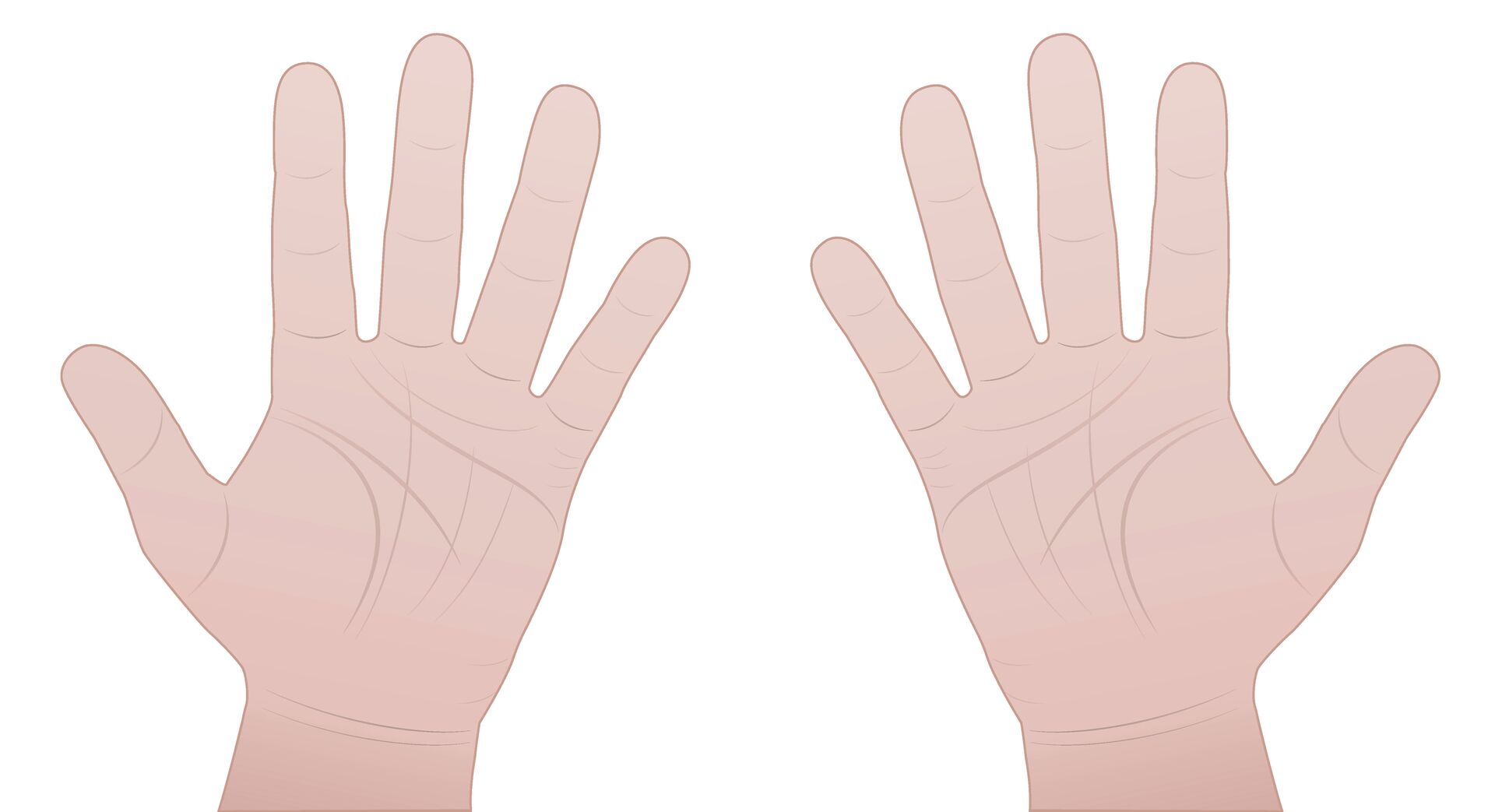
Select a line or mount on the palm to reveal its meaning
The Major Lines of Your Palm

The Heart Line
The Heart Line runs horizontally across the upper portion of your palm, and it is the first line most palmists examine.
This line governs your emotional world, not just romantic love, but your entire capacity for connection, compassion, and trust. In my experience, the Heart Line is the one people react to most during a reading. They'll nod at the Head Line, shrug at the Life Line, but when you describe their Heart Line, they go quiet. A deep, clearly marked one belongs to someone who feels profoundly, whose emotional experiences are vivid and memorable.
A line that curves upward toward the index finger reveals an idealist in love, someone who seeks a soul connection. One that stays straighter, ending between the middle and index fingers, speaks of someone more balanced between head and heart in relationships.
The length matters too. A long Heart Line reaching across the entire palm suggests someone generous with their affection, someone who gives freely. A shorter one often means more selective love, more carefully protected intimacy.
And those small branches reaching upward from the Heart Line? Those mark the relationships that lifted you. Branches reaching downward mark the ones that taught you through loss.
Read the full Heart Line guide →

The Head Line
Running horizontally across the center of the palm, the Head Line traces the pathway of your intellect. The Head Line shows how your mind works, its style of processing, not its horsepower. A straight Head Line speaks of practical, methodical thinking: someone who likes facts, evidence, and clear plans.
I can tell a creative thinker by the curve in their Head Line before they say a word about their work. That curve shows a mind that wanders productively, that makes connections between seemingly unrelated ideas, that thinks in images and metaphors as easily as in logic.
Where the Head Line begins tells its own story. If it starts joined to the Life Line, it suggests someone who took longer to find their independent thinking - perhaps closely guided by family in early life. A Head Line that starts separately indicates early intellectual independence, a child who questioned everything from the beginning.
The depth of this line reflects concentration and mental intensity: deep means focused, faint means flexible, and a chained or island-marked Head Line suggests periods of mental stress or scattered attention.
Read the full Head Line guide →

The Life Line
Let me address the myth directly, because I've read for hundreds of people who sat down terrified because someone told them their short Life Line meant early death. It doesn't. The Life Line has nothing to do with how long you will live. What the Life Line actually measures is something far more nuanced: the quality and vitality of your life force, the energy you bring to your existence, and the major transformations you undergo.
This line arcs from between the thumb and index finger, curving around the base of the thumb. A wide, sweeping arc suggests someone with enormous vitality - someone whose energy fills rooms, who lives with physical enthusiasm.
A Life Line that stays close to the thumb indicates someone more measured with their energy, more contemplative, who chooses their engagements carefully.
Breaks in the Life Line don't signal death. They mark reinvention. Those moments where the person you were ended and a new chapter began.
Read the full Life Line guide →

The Fate Line
Not everyone has a clearly visible Fate Line. Those without one are often the most interesting to read for. They've made every choice from scratch, with no sense of being carried. And people whose Fate Line starts mid-palm almost always have a story about their thirties being when everything finally clicked.
When present, the Fate Line rises vertically from the wrist area toward the middle finger, and it speaks to your sense of purpose - the degree to which you feel guided by something larger than circumstance.
A strong, unbroken Fate Line suggests a clear calling, a life shaped by vocation and direction. A fragmented one marks someone whose purpose has evolved through multiple chapters - not lost, but reshaped.
Where the Fate Line begins reveals the origin of that calling: from the base of the palm means purpose was evident from youth; beginning mid-palm suggests direction found through experience; and a Fate Line that emerges from the Head Line means intellectual passion illuminated the way.
Read the full Fate Line guide →

The Mounts: Where Your Energy Gathers
The mounts of the palm are the raised, fleshy areas that sit beneath each finger and around the edges of the hand.
In palmistry, each mount is associated with a planet, and the prominence of each mount reveals where your energy naturally concentrates - which qualities come easily to you, and which planetary influences shape your character most strongly.
What matters isn't just whether a mount is present or absent. Each mount has three possible states, and the differences between them tell a more complete story.
The Mount of Jupiter, beneath the index finger, governs ambition and leadership. Well-developed, it shows natural confidence and an appetite for responsibility. Flat, it suggests someone who leads quietly or prefers to support rather than direct. Overdeveloped, it can indicate ambition that overwhelms empathy - the drive to be in charge eclipsing the awareness of those being led.
The Mount of Saturn, below the middle finger, speaks to wisdom, discipline, and solitude. Well-developed, it marks someone with genuine depth and a capacity for concentrated work. Flat, it suggests someone more social, less inclined toward solitary reflection. Overdeveloped, it can show a tendency to withdraw too far - melancholy or rigidity masquerading as seriousness.
Apollo's Mount (the ring finger) radiates creativity and artistic sensibility. Full and firm, it indicates a natural relationship with beauty, self-expression, and the desire to be seen. A flat Apollo mount often points to someone who creates through less visible channels, writing rather than performing, designing rather than presenting. Overdeveloped, it can signal vanity or the need for constant external validation.
The Mount of Mercury beneath the little finger rules communication and wit. Well-developed, it shows a quick mind, social ease, and often a gift for language. Flat suggests someone who communicates more deliberately, choosing words with care rather than speed. Overdeveloped, it can indicate restlessness, superficiality, or the tendency to use words as shields rather than bridges.
The large Mount of Venus at the thumb's base is my fastest diagnostic. Within seconds of looking at someone's hand, its fullness or flatness tells me more about their energy than ten minutes of conversation would. Full and firm, it belongs to someone with enormous life energy: warmth, physical presence, generosity.
A flat Mount of Venus indicates someone who conserves energy or channels it inward, less outwardly expressive but often running deeper than people realize. An overdeveloped mount indicates someone whose vitality overwhelms their discrimination - passion running ahead of judgment.
Opposite it, the Mount of Luna carries your imagination and intuitive depth. And the Plain of Mars at the center tests your courage and resilience.
The same positive/negative/overdeveloped read applies to every mount on the hand. Each mount is a gauge of how much energy concentrates in that area of your life - and too much can be just as revealing as too little.
Read the full guide to palm mounts →
Minor Lines and Special Markings
Beyond the four major lines, several minor lines carry their own significance. The Sun Line (also called the Apollo Line) rises toward the ring finger and speaks of creative fulfillment, recognition, and the ability to find joy in your work. The Mercury Line runs diagonally and connects to health, intuition, and communication ability.
The Marriage Lines - those short horizontal marks below the little finger - represent significant committed relationships, not necessarily legal marriages. And the Bracelet Lines (Rascettes) at the wrist are classical markers of overall fortune and vitality.
How to Read Your Own Palm
If you'd like to begin reading your own palm, here's a simple approach to start with:
- Begin with your dominant hand. This reflects the life you're actively creating. Hold it under good light and relax your fingers naturally - don't stretch or clench.
- Identify the three major lines first. The Heart Line runs across the top, the Head Line across the middle, and the Life Line curves around the thumb. Most people can spot these easily.
- Notice the depth and clarity. Deep, clear lines indicate strong energy in that area. Faint lines suggest flexibility or underdevelopment. Chained or broken lines mark periods of challenge or reinvention.
- Feel your mounts. Press gently on the pads beneath each finger and around the palm's edges. Which feel fullest? Those reveal your dominant energies.
- Read the lines as a group, not in isolation. The most common mistake I see beginners make is reading each line separately. A deep Heart Line next to a faint Head Line tells a completely different story than a deep Heart Line next to an equally deep Head Line. The lines are in conversation.
- Compare both hands. Differences between your dominant and non-dominant hands reveal the distance between your innate nature and the life you've built. The bigger the difference, the more actively you've shaped (or been shaped by) your experience.

Palm Reading and Numerology: Two Maps, One Journey
If you're already familiar with numerology, you'll notice something striking about palmistry: the mounts of the palm are named after planets, and in numerology, each number carries planetary associations. Your Life Path number and the dominant mounts on your palm often tell the same story from different angles.
Someone with a Life Path 1, ruled by the Sun, will frequently show a prominent Mount of Apollo. A Life Path 7, governed by Neptune and the Moon, often correlates with a strong Mount of Luna.
These two systems - one reading the numbers in your birth date, the other reading the lines in your hand - are parallel languages describing the same truth about who you are. Neither replaces the other. Together, they create a richer, more dimensional portrait of your nature and purpose.
When Will It Happen? The Timing Question
The question I hear most often in readings is not "what" but "when." When will this relationship begin? When will this career shift happen? When will the pattern in my hand actually show up in my life?
This is where numerology enters the reading in its most practical form. Your birth number - the day of the month you were born, reduced to a single digit - generates a sequence of years that tend to bring the most significant events. A person born on the 1st, 10th, 19th, or 28th will find that years whose digits reduce to 1 tend to bring the sharpest turning points.
A palmist trained in both traditions can use your birth number to identify which years are most likely to bring the patterns your lines suggest. The hand shows the themes. The numbers suggest the timing. Together, they give a reading a specificity that neither system achieves alone.
Explore the full palmistry-numerology connection →
Questions Worth Asking
Which hand do you read in palm reading?
Read both hands. Your dominant hand (the one you write with) shows the life you're actively creating through your choices and actions. Your non-dominant hand reveals your innate nature, inherited traits, and the potential you were born with. Comparing the two shows how far you've traveled from your starting point.
Can the lines on your palm change over time?
Yes. The lines on your palms are connected to your nervous system and they change as your thought patterns, habits, and life circumstances evolve. Major life events, shifts in mindset, and personal growth can all alter the lines on your palm over months or years.
This is why periodic readings can reveal your ongoing growth. Learn more about the science behind changing palm lines.
Does a short Life Line mean a short life?
No - this is the most common misconception in palmistry. The Life Line reflects the quality and vitality of your life energy, not its duration. A short Life Line may indicate someone who is cautious with their energy or who experiences a significant reinvention. Many people with short Life Lines live long, full lives.
Is palm reading scientifically proven?
Palm reading is not recognized by mainstream science, though the medical field does use dermatoglyphics (the study of skin ridge patterns) for diagnostic purposes. The neurological density of the palm - and the documented correspondence between nerve-fiber pathways and the major palm lines - suggests the surface being read is far from arbitrary.
What palmistry offers is a symbolic framework for self-understanding - much like astrology or numerology, it provides a language for exploring personality, patterns, and potential that many find profoundly useful.
What if I don't have a Fate Line?
The absence of a Fate Line is common and is not a negative sign. It often indicates someone who is self-directed - a person who creates their own path through choice rather than following a sense of predetermined destiny. Many successful, purposeful people have no visible Fate Line at all.

Explore Palm Reading In Depth
- Heart Line: What Your Heart Line Reveals About Love and Connection
- Head Line: How Your Mind Actually Works
- Life Line: Vitality, Energy, and Transformation
- Fate Line: Purpose, Direction, and the Path You're Building
- Marriage Lines: Relationships, Commitment, and Emotional Bonds
- Mounts of the Palm: Where Your Energy Lives
- Hand Shapes: What Your Hand Type Reveals About You
- Palmistry and Numerology: Two Maps of the Same Journey
- Do Palm Lines Change? The Science Behind Your Living Hand
Explore more divination practices | Calculate your Life Path number | Read your birth chart
Palmistry is one part of a larger pattern. See how it connects to numerology, astrology, and tarot