The History of Numerology: 5,000 Years of Sacred Number
By Blair Andrews · Published February 15, 2010 · Updated May 10, 2026
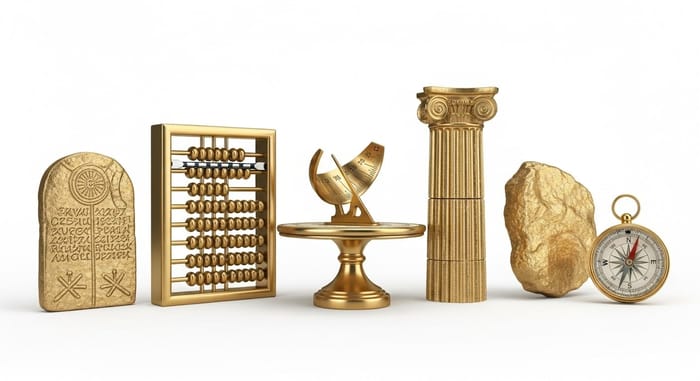
Sometime around 3500 BCE, a Sumerian priest pressed a reed stylus into wet clay and wrote the number 60 beside the name of Anu, god of heaven. The cuneiform sign for 60, combined with a star, became the ideogram for divinity itself. Below Anu in the cosmic hierarchy sat Enlil at 50, Ea at 40, the moon-god Sin at 30, and the sun-god Shamash at 20. Each deity carried a number the way a king carries a title, not as description but as identity.
For the Sumerians, arithmetic and theology were the same discipline. The number 3,600, written as a deformation of the circle, meant simultaneously "totality" and "cosmos." The structure of counting and the structure of heaven were, in their understanding, a single architecture. Mathematics, in that world, cannot be disentangled from numerology.
That entanglement lasted for thousands of years. It produced some of the most extraordinary intellectual achievements in human history. And its thread runs unbroken, sometimes underground, sometimes blazing in plain sight, from those clay tablets to the numerology practiced today.
I find this history personally grounding. Most numerology content online reads like it was written last Tuesday — and a lot of it was. Going back to the Sumerian tablets, the Pythagorean fragments, the Hebrew gematria tradition reminded me that the numbers I work with every day have been worked with for five thousand years. That depth changes how you hold the material. It stops being a self-help tool and starts being a window into how humans have always tried to find pattern in existence.

When Every Culture Heard Numbers Speak
The Sumerians were not alone. Across the ancient world, every major civilization independently arrived at the same conclusion: numbers are not just tools for counting. They carry meaning.
In Egypt around 3000 BCE, the number 3 held a special reverence as the principle of the trinity, the conviction that everything in existence manifests in three aspects. The hieroglyphic system indicated plurality by writing a sign three times.
But the Egyptians also embedded mathematical mysticism into their mythology. The Eye of Horus, torn into six pieces by the god Seth and reassembled by Thoth, was used by scribes to represent six basic fractions: 1/2, 1/4, 1/8, 1/16, 1/32, and 1/64. An observant apprentice once pointed out to his master that those fractions add up to only 63/64, not a whole. The missing 1/64, the master replied, was supplied by Thoth's magic - the fragment of wholeness that only divine intervention can provide.
In China, the oldest number symbols appear not in accounting ledgers but on oracle bones and tortoise shells from the fourteenth century BCE. Priests inscribed questions on the ventral side of blessed shells, then brought the other side near fire. The pattern of cracks was read as communication from the spirit world. Writing was sacred before it was practical. Number-signs may have had essentially magical roots, each one representing the "reality" of its corresponding number. Chinese numerology eventually organized itself around the yin-yang principle (odd numbers heavenly and active, even numbers earthly and receptive) and developed an obsession with phonetic resonance that persists powerfully today. The number 8 is supremely lucky because ba sounds like fa, prosperity. The number 4 is feared because si sounds like death. The Beijing Olympics opened on 8/8/08 at 8:08 p.m. for precisely this reason.
In India, astronomers expressed numerical data through Sanskrit poetry - word-symbols where 3 could be "fire" or "time," and zero was shunya, the void. These were not literary flourishes. Sanskrit was considered the language of the gods, and expressing numbers through its imagery was a theological act. The mathematical zero itself was born from the Indian philosophical conviction that emptiness is not absence but a positive principle, the uncreated, eternal element that penetrates everything. The idea that nothing could be something required a civilization that had already spent centuries contemplating the void as sacred.

Pythagoras: The Hinge of History
Pythagoras was born on the island of Samos around 570 BCE, and the Oracle at Delphi reportedly foretold that he would become useful to all people throughout all time. It was the kind of prophecy that invites skepticism - one scholar wondered whether a person credited with so many achievements could ever have existed at all. But the tradition that clusters around his name, whether produced by one man or by the school he founded, changed how the Western world understood numbers permanently.
What the ancient sources agree on is that Pythagoras spent decades studying abroad before he ever began teaching. He traveled to Egypt, where he studied geometry and the priestly mysteries. He went to Babylon, where he learned from Chaldean astrologers. By some accounts he reached Phoenicia, Persia, and India, touching every major center of learning in the ancient world. His goal was synthesis: to take each school's partial truth and weave them into a unified understanding of how reality is built.
Around 530 BCE, approaching sixty, he finally settled in Croton on the southern coast of Italy and founded a school that was part philosophical academy, part spiritual community. Membership was open to both women and men, a remarkable fact for the sixth century BCE. Students spent their first five years in complete silence, listening. All were vegetarian. All were sworn to secrecy. (And yes, five years of silence. Try imagining that in a modern university.) The school combined mathematical study with meditation, purification, and the pursuit of what the Pythagoreans believed was divine wisdom.
The central doctrine was breathtaking in its ambition: all is number. This was not a metaphor. The Pythagoreans believed that the elements of numbers were the elements of everything, and that the entire universe was a proportion.
Numbers, in their view, were not abstractions. They were living forces - "almost human in their capacity for mutual influence," with "attractions, repulsions, families, friends." They could be generous or miserly, active or passive, procreators or progeny. The modern numerological idea that each number has a distinct personality and energy traces directly back to this conviction.
Then Pythagoras made a discovery that seemed to prove the doctrine true. He found that musical harmony - something experienced subjectively, emotionally - could be expressed as simple ratios of whole numbers. A string twice as long produces a note one octave lower. A string 3/2 as long produces a fifth. If beauty itself obeyed mathematical law, then perhaps everything did.
The Pythagoreans extended the insight to cosmology and proposed that the planets and stars produce an ever-present harmony as they move through heaven - a Music of the Spheres that is latent in our innermost being, connecting us to the larger harmony of the universe. Pythagoras himself was said to be the only human pure enough to actually hear it.
The school revered the number 10 as "the mother of all numbers" and represented it as the Tetractys - a triangular figure of ten dots arranged in four rows: 1, then 2, then 3, then 4. The point. The line. The plane. The solid. And their sum: completeness, the return to unity at a higher level. Pythagorean students swore their most solemn oaths by this figure.
And the Pythagorean theorem? Its underlying relationship - the pattern connecting the sides of a right triangle - was known in Babylon a thousand years before Pythagoras was born. This is worth mentioning not to diminish him but to illustrate a pattern that runs through the entire history of numerology: ancient writers attributed all of a school's discoveries to its founder, and separating what Pythagoras himself actually taught from what was later credited to him is nearly impossible.
What is certain is how it ended. Around 495 BCE, Pythagoras and many of his followers were persecuted and killed. The schools were burned. The libraries were destroyed. Much of their teaching survived only through fragments and second-hand accounts. Despite this destruction, a classical scholar wrote more than two thousand years later that "if the glory of a philosopher is measured by the duration of his doctrine and the extent of the places that embraced it, nothing can equal Pythagoras."

Letters Become Numbers: Gematria and Isopsephy
In the Hebrew tradition, as in Greek and Arabic, letters served double duty as numerals. Every word had an inherent numerical value. Every sentence was simultaneously a mathematical statement. The theological implications were enormous: if God created the world through speech, and speech is inherently numerical, then the numerical structure of language reveals the numerical structure of creation.
The practice of calculating these values and finding correspondences between words that share them is called gematria, and it became one of the most sophisticated systems of number mysticism in human history.
The Hebrew words for "love" and "one" both equal 13. Their sum - 26 - is the numerical value of YHWH, the sacred four-letter name of God. Love plus unity equals the divine name. A Kabbalistic manuscript in the Bodleian Library at Oxford lists more than seventy different systems of gematria, each with its own rules for bringing words into concordance.
The Greeks developed their own version, called isopsephy. At Pompeii, someone inscribed "I love her whose number is 545" - a coded valentine written in arithmetic. The historian Suetonius noted that Nero's name in Greek had the same numerical value (1,005) as the phrase "he killed his own mother." A mathematical confirmation of what the entire empire already knew.

The Church, the Underground, and the Newton Divide
In 325 CE, the First Council of Nicaea established doctrinal boundaries for Christianity, and departures from orthodox belief were classified as civil violations within the Roman Empire. Divination practices - numerology, astrology, various forms of magic - were pushed to the margins. But gematria could not be fully suppressed, because early biblical texts were written in Greek and Hebrew alphabets where letters doubled as numbers. You could not read scripture without encountering numerical structure. Church fathers like Augustine used number symbolism extensively in their biblical interpretation, even as the institutional Church restricted its popular practice.
The neo-Pythagorean philosopher Nicomachus of Gerasa wrote an arithmetical introduction in the second century that influenced Western mathematical thinking throughout the Middle Ages. Boethius, in the late fifth century, transmitted Pythagorean number philosophy to the medieval West through treatises that remained standard textbooks for hundreds of years. Number mysticism did not die. It changed address.
Then came what might be called the Newton Divide. Sometime around the late seventeenth century, commerce and science placed new demands on numbers. They became practical tools: instruments for navigation, trade, engineering.
The qualitative understanding of number - the conviction that 4 means something beyond its quantity, began to separate from the quantitative one. Mathematics went one direction. Mysticism went another.
But mysticism did not disappear. It went underground. The Freemasons, the Rosicrucians, and other esoteric orders preserved Pythagorean and Kabbalistic number symbolism through the eighteenth and nineteenth centuries. In Renaissance France, academies were built explicitly on Pythagorean assumptions about numbers and harmony.
The split between quantitative and qualitative understanding of number was real, but it was never absolute. Even Newton devoted enormous energy to biblical chronology. Even Kepler was driven by Pythagorean convictions about cosmic harmony. The esoteric thread never broke. It just became harder to see.

Atlantic City, 1908: The Mothers of Modern Numerology
The modern practice of numerology - the specific system used by most practitioners and websites today - has a surprisingly precise origin. It was built, over a span of about fifty years, by three American women.
The first was Mrs. L. Dow Balliett, born Sarah Joanna Dennis in 1847. A devoted student of the Bible, Pythagoras, and Plato, she spent decades synthesizing these sources into a practical system she called "The Balliett System of Number Vibration." Her first book, The Philosophy of Numbers, appeared in 1908. By 1911, she was principal of the School of Psychology and Physical Culture in Atlantic City, New Jersey, lecturing on the spiritual significance of color, sound, and vibration.
Balliett's most important innovation was systematically assigning numerical values to the letters of the English alphabet and developing interpretive frameworks for the resulting numbers - the foundation of modern name numerology.
The general principle of letter-number correspondence was ancient, inherited from Hebrew gematria and Greek isopsephy. But Balliett adapted it specifically for English and created a workable method for analyzing names that anyone could learn.
She also reported an experience that connected her directly to the Pythagorean lineage. While traveling overnight by train, she claimed to have heard the Music of the Spheres - describing it as "faint, glorious music that arose from the depths of earth and sea, silvery, watery, fiery, and the unity of the whole so blended that it filled me with awe." Whether you take this literally or as a metaphor for the kind of perception that deep study opens, it places her firmly within the tradition she drew from. She died in 1929 at the age of 82.
The second key figure was Julia Seton Sears, M.D., founder of the New Age Thought Church and School and a friend of Balliett's. Around 1912, she coined the term "Numerology" - giving the ancient practice a modern name that made it accessible to twentieth-century seekers.
The third was Dr. Juno Jordan. Seton's fourteen-year-old daughter had studied directly with Balliett, absorbing the system at its source. As an adult, she founded the California Institute of Numerical Research, which operated for twenty-five years, conducting systematic studies of how numbers correspond to personality traits, life events, and human potential. Through the Institute's work, several foundational tools of modern numerology were developed or formalized: the Pinnacles, the Challenges, the Planes of Expression, the Table of Events. These are the structures that give a numerology chart its depth and specificity.
Dr. Jordan died in 1984, two months before her hundredth birthday, having dedicated nearly nine decades to the development of the practice. Together, Balliett, Seton, and Jordan are the reason modern numerology exists in its current form. Most calculators, most interpretive frameworks, most of what you encounter when you look up your Life Path Number or Expression Number online descends from their work.

What the History Actually Means
Here is the honest framing: modern numerology is a twentieth-century practice built on a five-thousand-year-old philosophical tradition.
The principle that numbers carry qualitative meaning - that they are not just quantities but living forces with character and significance - is genuinely ancient. It runs through Sumerian temples, Egyptian mystery schools, Chinese divination, Indian philosophy, Pythagorean academies, Hebrew mysticism, and medieval cathedrals. That philosophical lineage is real, cross-cultural, and remarkably persistent.
The specific system most Western practitioners use today - the letter-number chart, the Life Path calculation, the Soul Urge, the Personal Year cycle - was built by Balliett and Jordan in the first half of the twentieth century. When this system is called "Pythagorean," the label honors the philosophical lineage. It does not mean Pythagoras sat down and designed a chart for analyzing English names.
Both parts of this story matter. The ancient roots give the practice its depth and its resonance across cultures. The modern development gives it practical tools that people can actually use. Neither part alone tells the whole truth. The history of numerology is the story of an idea - that number is the language of reality itself - passed down through five millennia of human hands, each generation translating it into the form their own world could hear.

Frequently Asked Questions
Who invented numerology?
No single person invented numerology. Sophisticated number-symbolic systems existed independently in Sumer, Egypt, China, and India thousands of years before Pythagoras was born. Pythagoras synthesized multiple traditions into a unified philosophy and transmitted it to the Western world, which is why he is often called the father of numerology. The modern system most people use today was largely developed by Mrs. L. Dow Balliett and Dr. Juno Jordan between 1908 and 1960.
How old is numerology?
The principle that numbers carry qualitative meaning dates back at least 5,500 years to Sumerian civilization, where gods were identified by specific numbers and mathematical structure was understood as divine architecture. The specific system used by most modern Western practitioners - Life Path numbers, Expression Numbers, Personal Year cycles - dates to the early 1900s.
What happened to numerology after the Council of Nicaea?
After the Council of Nicaea in 325 CE, divination practices including numerology were pushed to the margins of official Christian culture. However, gematria - the practice of finding numerical values in words - could not be fully suppressed because biblical texts were written in Greek and Hebrew alphabets where letters doubled as numbers. Number mysticism continued through church scholars like Augustine and Boethius, and later through esoteric orders like the Freemasons and Rosicrucians.
What is the difference between Pythagorean and Chaldean numerology?
Pythagorean numerology assigns numbers 1 through 9 to the letters of the alphabet in sequence and is the most widely used system today. Chaldean numerology, which claims older Babylonian roots, assigns numbers based on the vibrational quality of each letter, uses only numbers 1 through 8 in letter assignments (keeping 9 as sacred), and analyzes the commonly used name rather than the birth certificate name. Most online calculators use the Pythagorean method.
Why is numerology called Pythagorean if Pythagoras did not create the modern system?
The label "Pythagorean" honors the philosophical lineage rather than claiming direct authorship. Pythagoras articulated the principle that numbers are the fundamental reality underlying all existence and developed the first systematic Western approach to understanding their qualitative properties. Modern numerology inherited this philosophical framework and adapted it into practical tools for name and date analysis. The connection is philosophical, not biographical.